Water Damage Categories 1, 2, and 3 Explained
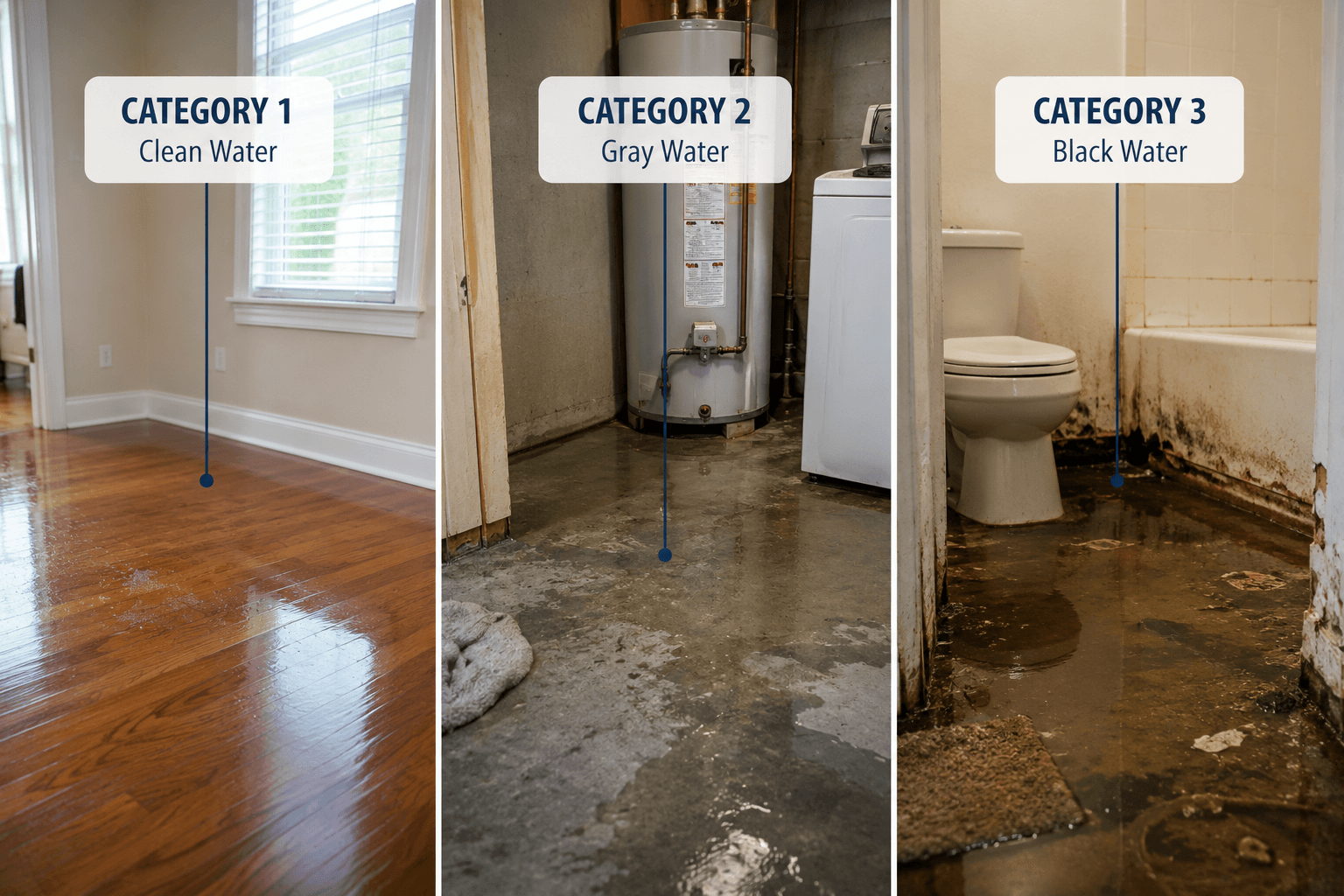
When a restoration technician tells you your loss is Category 2, that is not jargon for how bad it looks. It is a specific classification from the IICRC S500 standard, and it determines what can be dried and saved, what has to be removed, and what the job costs.
Understanding the categories tells you why two floods that look identical can be handled completely differently.
Key Takeaways
- The IICRC S500 standard defines three water categories based on contamination, not on volume.
- Category is not fixed. Clean water degrades toward contaminated water with time, temperature, and what it touches.
- Category determines what gets dried in place and what has to be cut out and thrown away.
Where the Categories Come From
The IICRC, the Institute of Inspection, Cleaning and Restoration Certification, publishes the ANSI-accredited S500 Standard for Professional Water Damage Restoration. It is the reference document the industry works from, and insurance adjusters evaluate scopes against it.
S500 classifies water by its source and its level of contamination at the moment of assessment. That classification then drives the remediation protocol.
Category 1: Clean Water
Category 1 originates from a sanitary source and does not pose a substantial risk from ingestion or contact. Typical sources include a broken supply line, a tub or sink overflowing with no added contaminants, or an appliance failure on the supply side.
Because the water itself is clean, the work is primarily a drying problem. Carpet, pad, drywall, and framing can often be dried in place with proper equipment rather than removed, which makes Category 1 the least destructive and least expensive scenario, provided it is addressed quickly.
Category 2: Gray Water
Category 2 carries significant contamination and has the potential to cause discomfort or illness on contact or ingestion. Common sources are dishwasher or washing machine discharge, toilet overflow containing urine but no solids, and sump pump failures.
The drying approach is similar in principle but the salvage decisions tighten. Carpet pad is typically discarded. Porous materials that absorbed the water are evaluated more conservatively, and antimicrobial treatment enters the scope.
Category 3: Black Water
Category 3 is grossly contaminated and can contain pathogens, toxins, and other harmful agents. Sources include sewage and toilet backflow beyond the trap, rising water from rivers or streams, and ground surface water carrying contaminants.
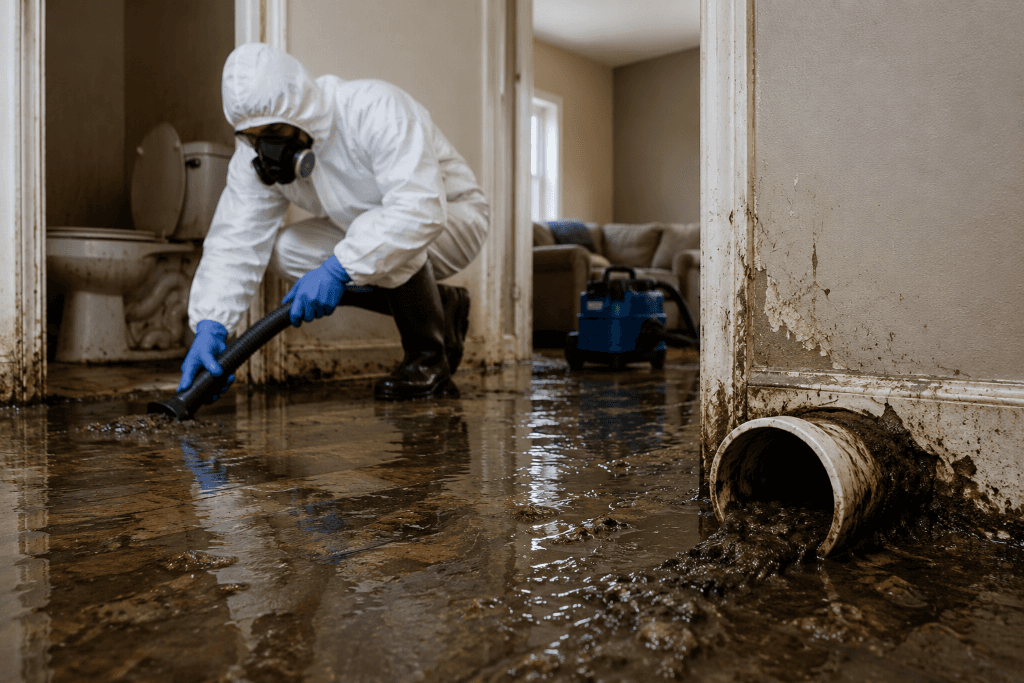
This is not a drying job with extra caution; it is a decontamination job. Porous materials that contacted Category 3 water, including drywall, carpet, pad, and insulation, are generally removed rather than cleaned. Crews work in personal protective equipment under containment. Our sewage cleanup service covers this work specifically, and CDC guidance on sewage and floodwater safety is worth reading before you enter the area at all.
Categories Degrade Over Time
This is the point most homeowners miss, and it is the reason restoration companies push so hard on response time.
A Category 1 loss does not stay Category 1. Clean water sitting against drywall, carpet backing, and subfloor picks up contaminants from the materials themselves. Add Charlotte's warmth and humidity, which accelerate microbial activity, and a clean-water event left for several days can reasonably be reassessed as Category 2 or worse.
The practical consequence is financial. The same burst pipe addressed in hours is a drying job. Addressed in a week, it can become a demolition job, because materials that could have been dried now have to be removed.
Why Category Drives Cost and Demolition
The relationship is straightforward: as contamination rises, the proportion of material that can be safely dried in place falls.
- Category 1 favors drying in place, with minimal removal.
- Category 2 means selective removal of porous materials plus antimicrobial treatment.
- Category 3 means removal of affected porous materials, containment, PPE, and disinfection.
That is why a Category 3 loss over the same square footage costs substantially more. You are paying for demolition, disposal, decontamination, and rebuild rather than equipment and monitoring.
Category Is Not the Same as Class
S500 also defines four classes, and the two are frequently confused. Category describes contamination. Class describes how much water the materials absorbed and how difficult the structure will be to dry.
- Class 1 involves the least absorption, affecting a small portion of the area with minimal moisture in porous materials.
- Class 2 involves a significant amount, with an entire room of carpet and cushion affected and moisture wicking up walls.
- Class 3 involves the greatest amount, typically water coming from overhead and saturating ceilings, walls, insulation, and subfloor.
- Class 4 covers specialty drying, where moisture is bound deep in low-porosity materials such as hardwood, plaster, concrete, or stone.
A loss has both a category and a class. Category 1 Class 4 is clean water bound in hardwood, which requires patient specialty drying. Our structural drying work is built around exactly these distinctions.
Frequently Asked Questions
How quickly does Category 1 water become Category 2?
There is no fixed clock, because it depends on temperature, humidity, and what the water contacts. The practical guidance is that the risk rises meaningfully after the first day or two, which is why fast extraction matters.
Can Category 3 materials ever be saved?
Non-porous materials such as glass, metal, tile, and sealed surfaces can generally be cleaned and disinfected. Porous materials that absorbed Category 3 water are normally removed.
Who decides the category on my job?
The restoration technician assesses it on site based on source and condition, documents the basis, and the classification carries into the scope your adjuster reviews.
Does the category affect my insurance coverage?
Category affects the scope and cost rather than coverage itself. Coverage turns on the cause of loss, which is why a sewage backup may need a specific endorsement. See our insurance claims guide.
Water Damage in Your Charlotte Home?
Category is assessed on site, and it changes the longer water sits. The single most useful thing you can do is shorten that window.
Our water damage restoration team in Charlotte assesses category and class on arrival, documents the basis for both, and works the job to the S500 standard.