

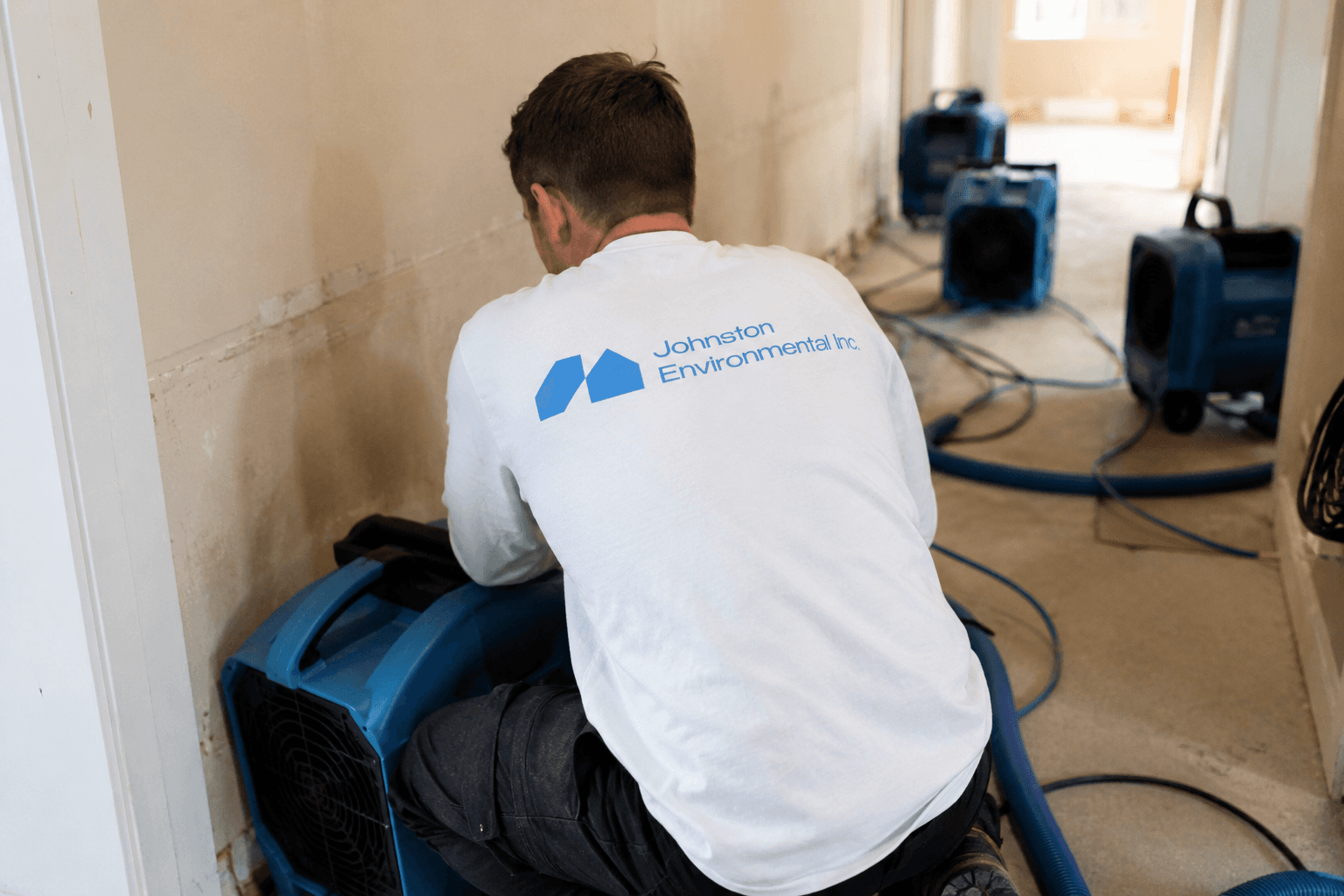
The Structural Drying Process We Run in Charlotte
Drying is a controlled system, not a pile of rented fans. Every Charlotte job gets a psychrometric plan, placed equipment, and daily verification. Here is the sequence.
Map the Moisture First
Moderate water losses hide most of their water inside walls and under floors. Moisture meters and thermal imaging build a wet map of the whole affected area. Plaster in a Dilworth bungalow reads differently than drywall in a Ballantyne build, and the map accounts for that.
Calculate the Drying Plan
Effective drying balances temperature, humidity, and airflow inside precise ranges. Our technicians run the psychrometric numbers and size equipment to the actual wet load. The plan says how many machines, where they point, and what target each material must hit.
Extract Before Evaporating
Pulling liquid water out is hundreds of times faster than evaporating it. Our water damage restoration crews extract standing water first. Dehumidifiers then work on what extraction cannot reach.
Place LGR and Desiccant Units
Commercial LGR dehumidifiers remove 100-plus pints of water per day. High-velocity air movers push wet air to them, and desiccant units take over for dense materials and extreme conditions. Placement follows the plan, not habit.
Open Only What Must Open
Dry-in-place saves drywall, trim, and cabinets whenever the numbers say it will work. Demolition needs justification here, not the other way around. Less tear-out means a shorter rebuild and a smaller claim.
Monitor Daily, Adjust Daily
Calibrated data loggers track every room around the clock. A technician reads the meters daily, moves equipment as materials hit targets, and logs it all. Drying plans that never change are plans nobody is checking.
Prove Dry Standard
The job ends when readings hit dry standard, documented with photos and thermal images. You keep the final report for your insurer and your records. If a mold question ever comes up later, that file answers it.
Drying Work We Take On Around Charlotte
Different materials give up water at wildly different rates. The equipment mix changes with the structure, so we scope each of these separately. All four end at the same documented dry standard.
Whole-Structure Drying After a Water Loss
Burst pipes and appliance failures soak floors, walls, and everything between. We dry the full envelope in one coordinated setup instead of chasing rooms one at a time. Most homes come back to dry standard within days.
Hardwood Floor and Subfloor Drying
Cupped hardwood is not automatically lost. When drying starts quickly, controlled dehumidification can pull boards back toward flat and save the floor. The meters tell us early whether saving beats replacing.
Wall Cavity and Crawl Space Drying
Water runs into cavities and vented crawl spaces and stays there. We dry cavities with directed airflow and treat crawl spaces as their own drying zones. In Charlotte's older neighborhoods, the crawl space is usually the wettest room in the house.
Post-Flood and Post-Storm Dry-Outs
After rising water, drying follows cleanup as its own phase. Our flood cleanup crews handle the contamination side; the drying plan brings the structure back to baseline. One team, one schedule, no gaps between phases.
Why Charlotte Structures Hold Moisture
Charlotte buildings fight the drying process in ways drier climates never see. Knowing where water hides is most of the job. These five conditions drive it.
Humidity That Refuses to Help
Summer air here routinely carries humidity above 70 percent, per National Weather Service readings. Opening windows in July adds water to the house instead of removing it. Controlled dehumidification is the only reliable exit for that moisture.
Dense and Layered Materials
Streetcar-era plaster, double subfloors, and modern engineered assemblies all trap water in layers. The top layer dries and the buried one festers. Meters and thermal imaging see what hands cannot feel.
Hidden Cavities and Chases
Water follows gravity into wall cavities, under cabinet toe-kicks, and along duct chases. Those spaces have no airflow, so they dry last or never. Targeted cavity drying reaches them without gutting the room.
Vented Crawl Spaces
Older Charlotte homes breathe through foundation vents, which pull humid summer air under the floor. After a leak, that crawl space moisture has nowhere to go. Left alone, damp joists become a structural and mold problem at once.
Cool Slabs and Basements
Concrete absorbs water slowly and releases it even slower. A slab that took water keeps feeding moisture back into flooring for weeks. Basement walls below grade do the same in every season.
Signs a Space Never Really Dried
Plenty of Charlotte homes got fans for a week and a thumbs-up. Months later, the building tells the truth. These are the signals that moisture stayed behind.
A Damp Smell Weeks After the Leak
Odor that outlives the visible damage means water is still trapped somewhere. Musty air in summer is the classic giveaway. A moisture survey finds the source in an hour.
Baseboards That Keep Swelling
MDF and trim wick water from damp drywall and framing behind them. If baseboards swell or the caulk line keeps cracking, the wall behind is not dry. Replacing the trim without drying the wall repeats the cycle.
Paint That Bubbles Back
Fresh paint over a wet substrate blisters within weeks. Each repaint looks fine briefly, then fails the same way. The fix is drying the material, not another coat.
Cupped Hardwood That Will Not Settle
Boards that stay cupped after weeks are still reading wet from below. Subfloor moisture keeps feeding them from underneath. Meter readings across the floor grid confirm it fast.
Condensation on Ducts and Windows
Sweating supply ducts and fogged panes point at indoor humidity the AC cannot keep up with. After a water loss, that often means evaporation is still happening somewhere. The moisture has to be coming from something wet.
What Sets Johnston's Drying Work Apart
Anyone can rent air movers. Verified structural drying is a different trade, and it is the one we practice. Here is what that means for your house.
ASD-Certified, Data-Driven
Our technicians hold Applied Structural Drying certification, the IICRC specialty for exactly this work. Psychrometric math decides the plan; meters decide when it is finished. Opinion never enters the schedule.
Commercial Equipment, Correctly Sized
LGR dehumidifiers pulling 100-plus pints daily, desiccants for the dense stuff, and calibrated data loggers on every job. The gear matters less than the sizing. Too few machines fail slowly; too many waste your claim.
Daily Readings You Can Actually See
Every monitoring visit produces a readable report: what measured wet, what hit target, what moved. You watch the house get drier on paper. No mystery, no trust-me.
Documentation Adjusters Accept
Drying logs, thermal images, and a dry-standard clearance letter close claims cleanly. When coverage applies, billing goes straight to the carrier. The paperwork is part of the product.
Dry-In-Place Over Tear-Out
We justify every square foot of demolition against the drying math. Saving materials shortens the project and keeps your home livable through it. Rebuilds should be measured in days, not seasons.
Twenty Years of Charlotte Buildings
Two decades of local work taught us how plaster, pine framing, and slab construction each hold water here. We are locally owned and still on every job after the equipment leaves. The house gets dry; the file proves it.
Drying Coverage Across the Charlotte Metro
Wet framing does not wait, so drying equipment stages within an hour of most of the metro. Coverage runs about 40 miles out from Charlotte in every direction.
In town, crews work Myers Park, Dilworth, Plaza Midwood, NoDa, Cotswold, SouthPark, Ballantyne, University City, and Steele Creek. Every housing era in those neighborhoods dries differently, and we have met them all. The suburban ring is daily territory: Matthews, Mint Hill, Pineville, Indian Trail, Stallings, Waxhaw, and Weddington to the south and east. Huntersville, Cornelius, Davidson, Mooresville, Concord, Kannapolis, and Harrisburg hold the north.
West-side calls cover Gastonia, Belmont, and Mount Holly. Across the state line, we run Fort Mill, Rock Hill, Tega Cay, and Indian Land. Somewhere else nearby? Call and ask; the answer is usually yes.
Structural Drying, Explained in Plain Terms
Drying is the least understood step in restoration, and the most skipped. These answers cover what Charlotte homeowners ask us most. The meters back every one of them.
How long does structural drying take?
Most residential dry-downs run three to five days with proper equipment. Dense materials like plaster, hardwood, and concrete can push longer. The daily readings, not the calendar, decide the finish line.
Why can't I just run fans and open windows?
Charlotte summer air often carries more moisture than the air inside your house. Open windows in July and you are importing water. Household fans move damp air around without removing a pint of it.
Do you provide drying reports for insurance?
Yes, daily logs plus a final clearance report with readings, photos, and thermal images. Adjusters get exactly what they need to close the claim. You keep a copy for resale questions later.
What is Applied Structural Drying?
ASD is the IICRC specialty certification for drying structures efficiently and completely. It covers psychrometrics, equipment sizing, and verification standards. It is the difference between renting fans and running a drying system.
Can wet drywall and hardwood be saved?
Often, yes, when drying starts fast enough. Per EPA guidance, materials dried within 24 to 48 hours usually avoid mold growth entirely. Speed is what makes dry-in-place possible.
Will the equipment run up my electric bill?
The machines draw real power, but only for a matter of days. We log exact run times for every unit, and that log goes in your claim file. Ask your adjuster about utility reimbursement; the documentation is ready.
The water was clean. Do I still need drying?
Clean water soaks framing and subfloors exactly like dirty water does. Left wet, those materials grow the same mold and warp the same way. Category describes contamination, not urgency.
What happens if something stays wet?
Mold can start inside 24 to 48 hours, and hidden damp feeds it for months. Warped floors, swollen trim, and musty odor follow. Everything on this page exists to prevent that outcome.
Get the Drying Plan Started Today
Every wet hour costs more of your flooring, drywall, and framing. Call Johnston Environmental at (704) 860-4062 and a crew can be placing equipment today. Professional structural drying in Charlotte, NC, measured daily and documented to dry standard. Stop guessing whether it is dry. Know.
Call (704) 860-4062 Now