

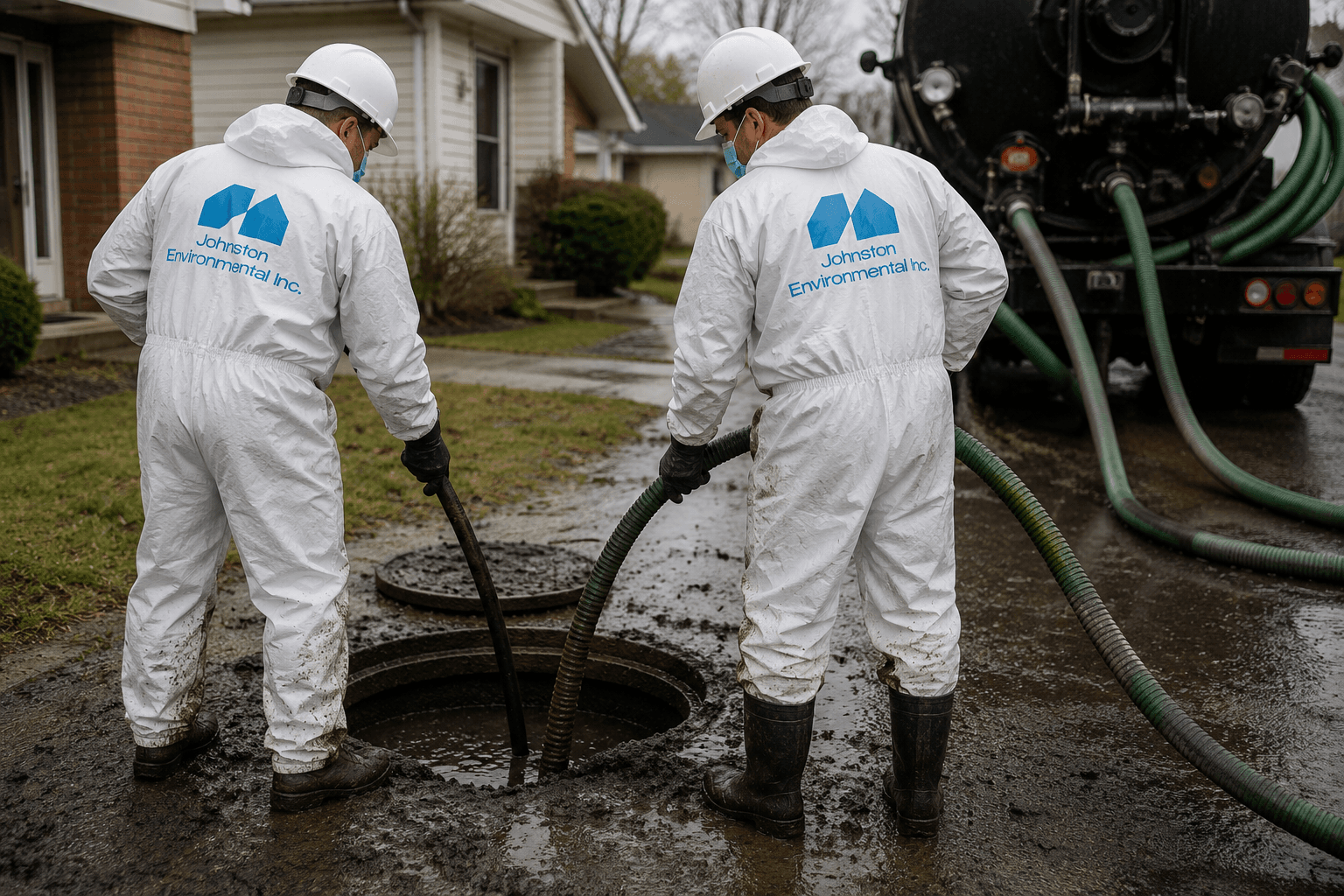
Who Owns the Pipe Under a Concord Yard
Concord runs its own wastewater collection system, and the flow ends up at the Rocky River Regional Wastewater Treatment Plant. That plant sits in Concord and is owned and operated by the Water and Sewer Authority of Cabarrus County. It handles up to 30 million gallons a day.
The city's own guidance draws the line clearly. The private connection running from your building to the main is the owner's to keep clear. Grease, wipes, and root intrusion in that stretch cause a backup nobody else will clear for you.
The city side fails too. In July 2026 roughly 2,000 gallons of untreated wastewater overflowed from Concord's system into a nearby creek. An overflow like that is a system event, not a homeowner error.
Rain ties the two together. WSACC has reported unprecedented rainfall on the Rocky River system, which is part of why the plant expanded. NOAA normals for Concord put annual rainfall at 47.87 inches, with July the wettest month at 5.31 inches.
Housing age decides which failure you get. The Union Street historic core still carries some of the city's oldest sewer connections, and mature street trees put roots into them. West of downtown, the post-2000 subdivisions have newer pipe but longer runs and heavier flow.
Signs a Concord Home Has a Sewage Problem
A backup rarely starts at the fixture you are looking at. These are the versions Cabarrus County callers describe most often.
Two or More Fixtures Backing Up Together in a West Concord Home
One slow drain is a fixture problem, and several at once is a line problem. In post-2000 subdivisions with long lateral runs, that pattern usually means the blockage sits well outside the house.
Gurgling Floor Drains After a Heavy Concord Rain
Storm flow entering the sewer system raises pressure in the mains. On the wet July days that bring Concord its 5.31 inches, gurgling drains can precede an actual backup by hours.
Sewage Surfacing in the Yard Above an Old Union Street Lateral
Older downtown connections give way at joints that roots have opened. A soft, foul patch of lawn above the pipe run means the failure is already outside the foundation.
A Sewer Smell in a Finished Basement Off North Union Street
Downtown homes with below-grade rooms trap gas that newer slab houses simply do not have. A persistent smell with no visible water still means contaminated flow somewhere below.
Sewage in the Basement and No Idea Whose Pipe Failed?
The contamination does not wait for that answer. Johnston Environmental starts containment and decontamination in Concord homes while the pipe question gets sorted out.
Call (704) 860-4062 NowHow We Work a Concord Sewage Backup
The sequence is fixed, but Concord addresses change the details. A Union Street basement and a Christenbury slab need different containment. Four steps carry every job.
Establish Whether the Failure Is Yours or the City's
The first question decides who else needs calling. If several fixtures back up at once, or neighbors report the same thing, it points at the city main. We help you report it to the City of Concord while our crew starts on the house.
Contain to Category 3 Standards Before Anything Moves
Sewage is Category 3 water under IICRC S500, so the work zone gets sealed before removal starts. In a Union Street home with a finished basement, that means isolating the stair run and shutting off the return air. On a Christenbury slab, containment stays on one level and focuses on the affected wing.
Remove What Category 3 Contact Condemns
Porous material touched by sewage does not get cleaned and returned. Carpet, pad, and wet drywall come out and get bagged, and the cut line goes above the visible tide mark. Framing, slab, and structural wood get cleaned, treated, and documented instead.
Confirm the Line Before Rebuilding Anything Back
Rebuilding over an unproven lateral just repeats the loss. On older Union Street and Mill Hill connections, root intrusion tends to return within a season. We wait for the plumbing repair or the city fix to be confirmed before closing a wall.
What a Concord Sewage Backup Actually Involves
Start with the scale of the system. The Rocky River Regional plant in Concord treats up to 30 million gallons a day for Cabarrus County.¹ A single house is a small part of that, until the flow reverses. In July 2026 about 2,000 gallons of untreated wastewater escaped Concord's system into a creek.² Rain drives much of it, and NOAA normals put Concord at 47.87 inches a year with July the wettest month.³ Then there is what lands on the floor. The IICRC classifies sewage as Category 3 water, grossly contaminated and capable of carrying pathogenic or toxigenic agents.⁴ That classification, not the size of the puddle, sets the scope of the cleanup.
- WSACC, Rocky River Regional Wastewater Treatment Plant facility page
- WBTV, 2,000-gallon sewage overflow in Concord sends wastewater into nearby creek, July 18 2026
- NOAA NowData 1991-2020 climate normals, Concord, NC
- IICRC S500, Categories of Water Damage
Why Concord Families Call Johnston Environmental for Sewage
Four different things go wrong in a Concord sewage loss, and they are not all plumbing. Here is what we take on.
We Read Concord's 30 MGD System, Not Just Your Fixtures
Concord drains to a 30 million gallon per day regional plant, and its mains overflow in wet months. Knowing how the collection system behaves tells us whether your backup started inside or outside the property line.
We Scope Below-Grade Union Street Rooms the Subdivisions Do Not Have
Finished basements sit below the sewer line downtown, and Christenbury or Moss Creek slabs do not. Cut height, drying plan, and salvage all change with that one difference.
We Haul Category 3 Waste Out of Cabarrus County Properly
Sewage-soaked carpet and drywall are contaminated waste, not ordinary building debris. Bagging, transport, and disposal are logged so the material does not end up back on your driveway.
We Refuse to Close a Concord Wall Over an Unproven Lateral
Rebuilding before the pipe is fixed simply buys you the same loss again. On older downtown connections we wait for the repair to be confirmed, then finish the reinstatement.
Concord Areas We Cover for Sewage Cleanup
Sewage work changes with the age of the connection and the depth of the lowest floor. Crews cover the historic core and the newer subdivisions alike.
Historic Downtown Concord
Below-grade rooms sit above some of the city's oldest sewer connections, so a backup reaches finished space quickly.
North Union Street
Victorian-era homes on original lateral runs, where mature street trees push roots straight through old joints.
Mill Hill
Cotton-mill-era cottages on tight lots, where shallow connections and shared alignments complicate access.
Edgewood Avenue
Older homes near downtown whose later additions sit on plumbing that was extended rather than replaced.
Christenbury
Slab-on-grade subdivision housing, where sewage spreads sideways across a floor plan instead of down into a basement.
Moss Creek
North Concord lots with long lateral runs to the main, so blockages usually sit well beyond the foundation wall.
Skybrook
Housing along the Cabarrus and Mecklenburg line, where the connection point decides which utility gets called first.
Afton Village
Compact neo-traditional lots where one blocked run can affect adjoining properties quickly.
Concord Sewage Cleanup Questions
Sewage calls come with questions that cannot wait for an appointment. Here are the answers we give on the phone.
Who is responsible for a sewage backup in Concord, the city or me?
It depends which pipe failed. The City of Concord's guidance is that the private connection from your building to the main is the owner's to keep clear. If the main itself overflows, that is a city system event. Concord had a 2,000-gallon overflow in July 2026.
Is there a public record if Concord's sewer main overflowed?
Overflows from the city system do get reported, and local news picks up the larger ones. Concord's July 2026 spill of roughly 2,000 gallons was reported that way. Ask the city for the record covering your street and date, because it supports a main-side claim.
Can I keep using the toilets while I wait for a crew in Concord?
No, stop all water use in the house, including washing machines and dishwashers. Every gallon you send down adds to what is already backing up into the lowest floor. If a neighbor is affected too, the blockage is likely in the city main.
Will a finished basement off Union Street be a total loss?
Rarely a total loss, but the porous material in it usually is. Carpet, pad, and the lower drywall come out, while framing, slab, and stair structure are cleaned and treated. Downtown homes lose more than slab houses because the sewage reaches finished space.
Why do Concord's newer subdivisions back up differently from downtown?
Two reasons: the pipe and the floor. West-side homes built after 2000 sit on slabs with long lateral runs. Blockages happen far from the house and spread sideways indoors. Downtown connections are older and shallower, and the sewage reaches finished basement space instead.
Not Sure Whose Pipe Failed in Your Concord Home?
Wondering whether that backup in your Christenbury or Union Street home is the city's main or your own lateral? Call (704) 860-4062 and we will start on the contamination while that gets answered. Johnston Environmental runs IICRC-certified crews, answers at any hour, and documents the cause for your insurer. We come up I-85 from Charlotte and target a 60-minute arrival anywhere in Cabarrus County.
Call (704) 860-4062 Now