

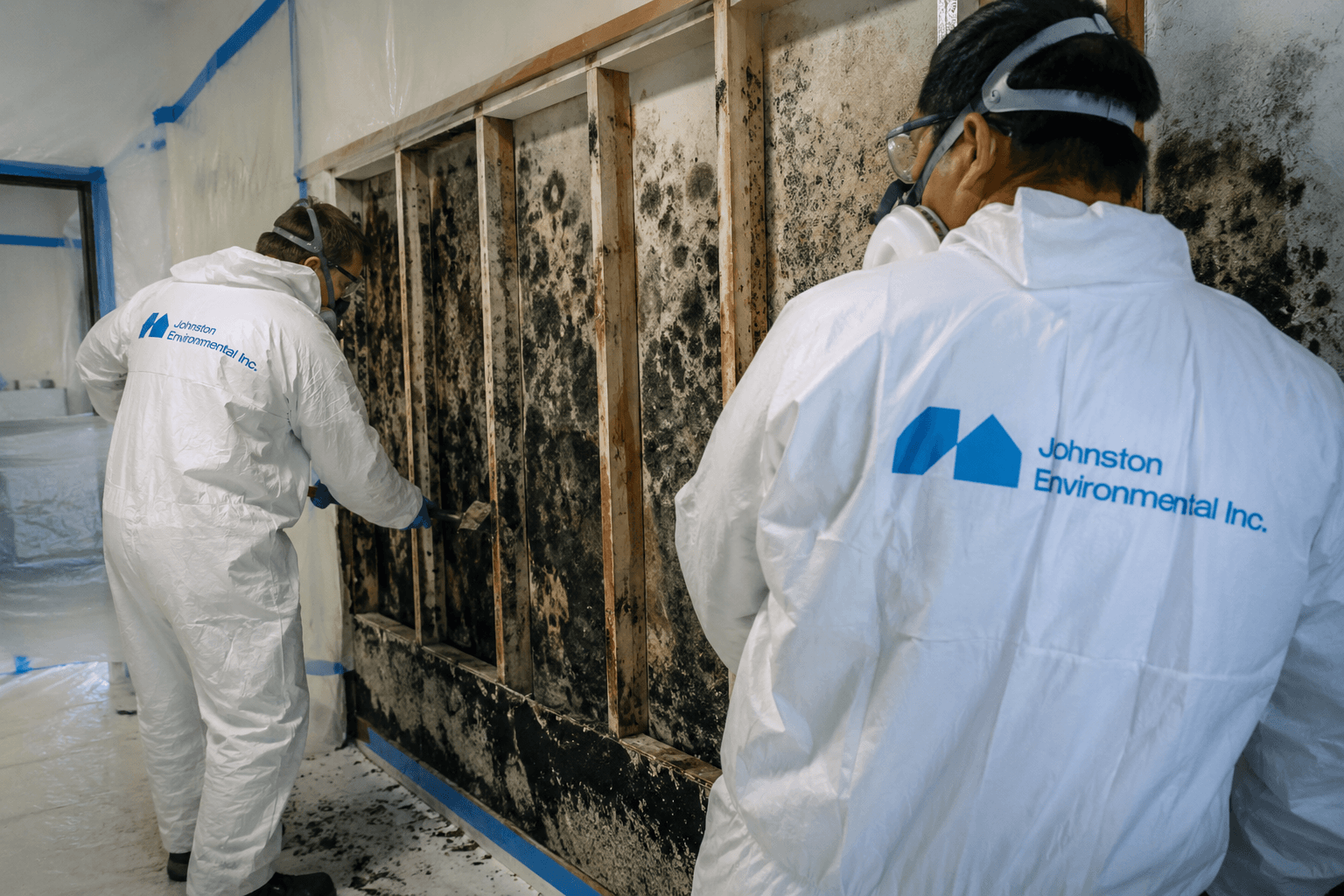
How Our Charlotte Mold Remediation Process Works
Ask three mold companies how they work and you will get three vague answers. Ours is specific, and it is the same on every Charlotte job. Here is the sequence, in the order you will watch it happen at your house.
Walkthrough and Moisture Map
The first visit covers the whole house, not just the room with the smell. Meters and thermal imaging chart every wet cavity onto a moisture map you keep. In Dilworth and Plaza Midwood bungalows, that map usually starts under the floor. In Cotswold's post-war ranches, we check the duct trunks too, since summer condensation stains ceilings from above.
Lab Samples Before Any Demo
Cutting first and asking questions later scatters spores. We draw air samples and surface swabs and send them to an accredited outside lab. Results usually land within a couple of business days. Species and spore counts shape the containment plan, and the report slots straight into a claim file or home sale.
A Sealed Zone Under Negative Pressure
Poly sheeting closes off the work area before the first cut. Filtered machines keep air flowing inward, so nothing drifts toward the kitchen or the nursery. Uptown condo or Matthews ranch, the barrier goes up the same way. Kids and pets stay home; the work zone stays sealed.
Cut Out, Bag Out
Wet drywall, insulation, and carpet pad leave the house in sealed bags, through the shortest path we can tape off. What stays is the structure itself. Demolition is surgical, not general.
Framing Scrubbed, Never Painted Over
Some outfits fog a chemical, roll on sealant paint, and call it a day. We vacuum, scrub, and sand rooted growth out of the wood first. EPA-registered products finish the cleaning, not replace it.
Dry-Down to Target Numbers
Commercial dehumidifiers run until wood and masonry hit dry-standard readings, not until they look dry. If a burst pipe or storm loss started the problem, our structural drying crew takes the wider wet-out. Readings get logged daily, and you can see the log whenever you want.
Fix What Fed It
Remediation without a source fix is a subscription, and we do not sell those. A failed supply line, a blocked bath vent, crawl space condensation: whatever fed the growth gets corrected before we close up.
The Final Say Goes to the Lab
Barriers stay up until post-work air samples pass at the same outside lab that read the first ones. You get the numbers, the photos, and a clearance letter for your records. Then the room is yours again.
Mold Services We Handle Across the Charlotte Area
Mold work is rarely one-size-fits-all. A hidden leak in a SouthPark condo needs a different plan than a flooded crawl space in Matthews. These are the four services we run most, and each stands on the same S520 playbook.
Mold Inspection and Air Quality Testing
Not sure whether that smell is mold? We inspect visually, sample the air, and swab suspect surfaces. Lab-verified results are ready for real estate closings, landlord disputes, and health documentation.
Containment and Mold Removal
This is the core remediation service: containment, negative air, removal, and cleaning. We handle single closets and whole basements with the same discipline. Every removal ends with clearance testing, not a handshake.
Mold Cleanup After Water Damage
Mold and water damage usually arrive together. Per EPA guidance, mold can start on damp materials within 24 to 48 hours. If a pipe burst or storm soaked your home, our water damage restoration team extracts, dries, and treats before growth takes hold.
Prevention Treatments and Moisture Control
After removal, we apply antimicrobial treatments and correct the conditions that fed the growth. That can mean sealing duct leaks, improving bathroom ventilation, or drying a chronically damp crawl space. Fix the moisture and the mold stays gone.
What Feeds Mold in Charlotte Homes
Charlotte gives mold almost everything it needs: warm air, long humid summers, and plenty of enclosed spaces. National Weather Service climate reports for the city routinely log summer humidity averages above 70 percent. Add a small water problem and growth follows fast.
Summer Humidity That Never Lets Up
From June through September, moisture hangs in Charlotte's air day and night. It condenses on AC ducts, cool basement walls, and uninsulated pipes. That thin film of condensation is enough to feed growth on dust and drywall paper.
Crawl Spaces Under Older Neighborhoods
Streetcar-era homes in Dilworth, Plaza Midwood, and Myers Park often sit on vented crawl spaces. Summer air enters, hits cool earth and ductwork, and condenses. Joists and subfloors stay damp for months at a time.
Slow Plumbing Leaks
A pinhole supply-line leak inside a wall can run for weeks unnoticed. The EPA notes that damp materials need to dry within 24 to 48 hours to prevent growth. A slow leak resets that clock every single day.
Storm Water and Roof Intrusions
Carolina thunderstorms drive water under flashing, through aging shingles, and into clogged gutters. One saturated attic deck or wet wall cavity becomes a colony within days. Storm season keeps our phones busy for a reason.
Ventilation Gaps in Newer Homes
Tightly built homes in Ballantyne and Steele Creek hold conditioned air well, but they also hold moisture. Bathroom fans that vent into the attic instead of outside are a classic culprit. So are dryer ducts that leak humid air into wall cavities.
When a Musty Smell Becomes a Real Problem
Most Charlotte homeowners call us months after the first clue appeared. Mold rarely announces itself in plain view. Here is what it looks like before you ever see a patch.
A Musty Odor You Cannot Locate
That earthy, damp smell that gets stronger in summer is the most common first sign. If it intensifies near closets, bathrooms, or the crawl space door, trust your nose. Odor means active growth somewhere air is reaching you.
Stains That Return After Painting
Paint does not fix a moisture problem, it hides one. When ceiling or wall stains bleed back through fresh primer, water is still moving behind the surface. Growth is usually not far behind.
Allergy Symptoms That Ease When You Leave
Congestion, itchy eyes, or coughing that improves at work and worsens at home is worth taking seriously. Indoor spore counts can run far higher than outdoor air when growth is active. Testing tells you for certain.
Warped Floors or Bubbling Paint After a Leak
If your home took water from a leak or storm, watch the materials. Cupping hardwood, swollen baseboards, and blistering paint all signal trapped moisture. Per the EPA's 24-to-48-hour window, growth may already be underway.
Visible Growth Around Vents and Windows
Speckling on supply-air vents, window frames, or closet ceilings often traces back to condensation. Small visible patches frequently point to larger colonies inside the cavity. What you can see is rarely the whole story.
Why Charlotte Homeowners Call Johnston Environmental
Mold work rewards patience and punishes shortcuts. The company you hire matters more here than in almost any other trade. This is the case for ours.
One Hour Out, Even at 2 AM
Mold problems usually announce themselves as water problems, and those cannot wait for morning. A crew reaches most of the metro within 60 minutes, every day of the year. The sooner the structure dries, the less there is to remediate.
S520 Discipline on Every Job
The IICRC S520 standard dictates our containment, removal, and clearance criteria. Our technicians carry current IICRC certifications and follow it without shortcuts. Mold remediation done by protocol is the whole product.
Claim Paperwork, Handled
Adjusters want cause, scope, moisture logs, and lab numbers. We build that file as we work and send it straight to your carrier. When coverage applies, the billing goes to them, not to you first.
One Name From Estimate to Clearance
A single job manager owns your project the whole way through. Same voice on the phone, same person walking the clearance results. You never re-explain your house to a stranger.
Twenty Years of Charlotte Houses
We are locally owned and have restored more than a hundred homes across two decades here. Century-old plaster in Myers Park behaves nothing like builder drywall in Ballantyne. Knowing the difference changes how the job gets scoped.
Proof First, Guarantee Second
Independent clearance testing shows the work succeeded before we ask you to sign off. If anything falls short, we make it right. That promise is written into every scope.
Our Mold Service Area Around Charlotte
Crews stage out of Charlotte and cover roughly 40 miles in every direction. Different corners of the metro grow mold for different reasons, and we work all of them.
In the city, that means Myers Park, Dilworth, Plaza Midwood, NoDa, Cotswold, SouthPark, Ballantyne, University City, and Steele Creek. The streetcar-era blocks bring crawl space calls; the newer tight-built homes bring condensation. Up the I-77 corridor we serve Huntersville, Cornelius, Davidson, and Mooresville, where Lake Norman keeps the air working on boathouses and basements. Concord, Kannapolis, and Harrisburg cover our northeast runs.
South and east, count on us in Matthews, Mint Hill, Indian Trail, Stallings, Waxhaw, Weddington, and Pineville. Gastonia, Belmont, and Mount Holly hold down the west side. Across the state line, Fort Mill, Rock Hill, Tega Cay, and Indian Land are all regular stops. If your town is not named here, call anyway. The zone keeps growing.
Charlotte Mold Questions, Answered
These come up on nearly every Charlotte estimate we run. The answers are short and honest, because you have enough to deal with. Anything else, ask when you call.
How much does mold remediation cost in Charlotte, NC?
Recent Charlotte cost data puts the average project near $2,400, with typical jobs between $1,100 and $3,800. A single contained closet can land closer to $500. Crawl spaces and post-flood projects run higher, so we price from a written scope, never over the phone.
What is the difference between mold removal and mold remediation?
Removal is one task: taking out the visible growth. Remediation is the full chain of custody, from moisture source to containment to verified clean air. Buy the first without the second and you will buy it twice.
Is mold remediation covered by homeowners insurance?
North Carolina policies typically cover mold that follows a sudden loss, like a burst supply line. Slow seepage and deferred maintenance usually are not. Our documentation shows the adjuster exactly which one happened, and we bill the carrier directly when coverage applies.
How long will my mold job take?
Plan on one to three days for a single contained room, including the clearance wait. A full crawl space or a post-flood house can run a week or more. The moisture map from the first visit sets the schedule, and you get it in writing.
What should I throw away after mold?
We sort salvage room by room rather than handing you a rule. As a baseline: saturated drywall, insulation, carpet pad, and moldy upholstery rarely survive. Framing, tile, metal, and glass almost always clean up and stay.
Do you handle crawl space and attic mold?
Yes, and in Charlotte those two spaces are where mold hides most often. Vented crawl foundations and under-insulated attic decks stay damp longest. Both get the full treatment: containment, removal, drying, and a corrected moisture source.
Do I need to move out during remediation?
Usually not. Containment and negative air keep the work zone sealed off from the rest of the house. If the affected area includes your only bathroom or the kitchen, we will tell you before we start.
Can I handle a small patch myself?
EPA guidance says patches under about 10 square feet are often a homeowner job. Fix the moisture first, wear protection, and never dry-scrape a colony. Hidden growth, HVAC contamination, or anything bigger belongs with a certified crew.
Do you test the air when the work is done?
Every time, through an independent lab, before containment comes down. The clearance report is yours to keep for insurance, records, or a future sale. If a sample fails, the crew goes back in until it passes.
Will the mold come back?
Mold needs three things: spores, food, and water. Spores are everywhere and your house is made of food, so we attack the water. Once the source is corrected and clearance passes, regrowth has nothing to run on.
Talk to a Charlotte Mold Specialist Today
Mold gets more expensive every week it stays wet. Whether you smell something in the crawl space or found growth after a leak, get answers now. Call Johnston Environmental at (704) 860-4062 for 24/7 emergency response and straightforward mold remediation in Charlotte, NC. One call brings a certified local crew, a clear scope, and a result we stand behind.
Call (704) 860-4062 Now