

What Happens When You Call Johnston in Charlotte
A water emergency runs on logistics, and ours are rehearsed. From the first ring to the finished rebuild, here is exactly what happens. No mystery phases, no waiting on callbacks.
The Call Sets Everything Moving
A real person answers and asks three things: the water source, how much is standing, and which floors are hit. The crew rolls while you are still talking. Most of the metro sees us inside 60 minutes.
Stop the Feed
If the source is still running, we walk you to the shutoff on the phone. On arrival, we isolate the failed line or appliance properly. Restoration starts by making sure the loss stops growing.
Thousands of Gallons an Hour, Out
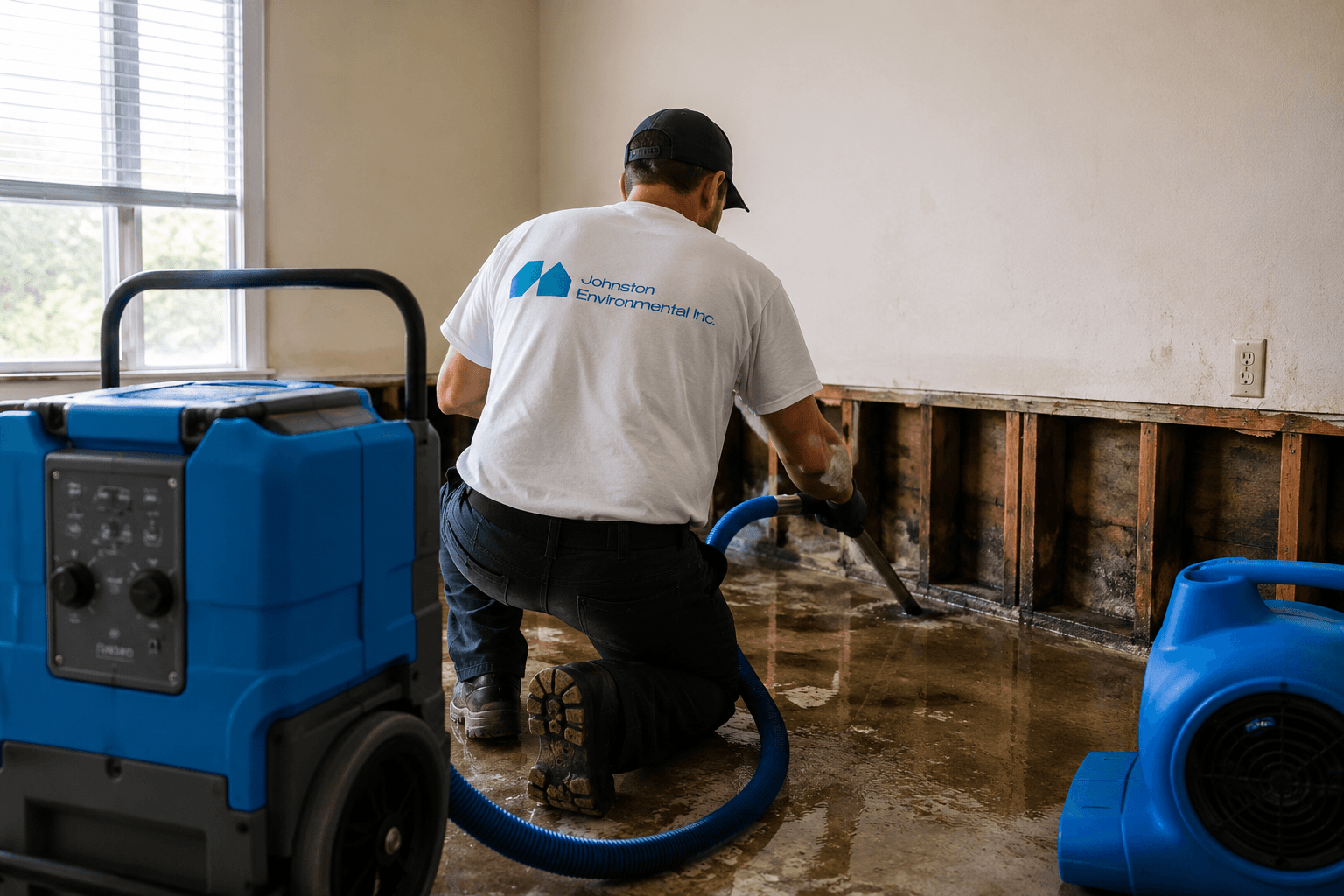
Truck-mounted extractors pull standing water at a pace shop vacs cannot touch. Carpets, hard floors, and basements clear fast. Extraction speed is the single biggest factor in what gets saved.
Find Every Wet Cavity
Thermal imaging and moisture meters trace water behind walls, under floors, and above ceilings. Hidden moisture is what turns a clean loss into a mold claim. Nothing gets closed up unexamined.
Sort It by Category
Clean supply water, gray appliance water, and black water each demand different handling, and we are certified for all three. Category 3 losses shift to our sewage cleanup protocol immediately. The category decides the cleaning plan, not convenience.
Dry to S500, Prove It Daily
LGR dehumidifiers and air movers run to IICRC S500 drying standards with daily meter checks. Our structural drying team logs every reading until the structure hits dry standard. You see the numbers, not just the equipment.
Rebuild Without the Handoff
Drywall, flooring, trim, and paint follow drying under the same contract. The manager who took your first call signs off on the last coat. One loss, one crew, one file.
Water Emergencies We Handle Across Charlotte
Most water losses start inside the house, not in the sky. These are the calls Charlotte makes to us most, and what each one needs. All four get the same 24/7 dispatch.
Burst Pipes and Supply Lines
A failed supply line can release hundreds of gallons before anyone notices. We stop the feed, extract fast, and open only what stayed wet. Winter freeze bursts get priority dispatch because they rarely happen one house at a time.
Appliance and Water Heater Failures
Water heaters, washing machines, dishwashers, and ice-maker lines fail quietly and flood thoroughly. These gray-water losses need cleaning as well as drying. We handle the category properly and document the failed part for your claim.
Ceiling and Upstairs Leaks
Water from an upstairs bathroom or roof penetration spreads across ceilings and down wall cavities. We map the travel path with thermal imaging before cutting anything. Controlled openings beat exploratory demolition every time.
Commercial Water Losses
Offices, retail, and restaurants cannot wait out a slow dry. We stage larger equipment sets and work around business hours where the loss allows. Downtime is part of the damage, so the plan minimizes it.
Where Charlotte Water Losses Start
After two decades of Charlotte water calls, the causes repeat. Five of them account for most of the losses we work. Knowing yours helps you prevent the next one.
Hard Freezes on Uninsulated Lines
Charlotte winters are mild until the one week they are not. Pipes in crawl spaces, garages, and exterior walls burst when hard freezes arrive. The thaw is when the flooding starts, and the calls come in waves.
Aging Supply Lines and Fittings
Homes from the busy 1980s and 1990s build-out are hitting the age where original plumbing fails. Polybutylene-era materials and worn fittings give out without warning. A ten-dollar part can cause a five-figure loss.
Water Heaters Past Their Prime
Tanks rust from the inside and fail at the bottom seam, usually after a decade of service. Forty or more gallons release at once, then the supply keeps feeding. Most sit in closets or attics where damage spreads silently.
Washing Machine and Ice-Maker Hoses
Rubber hoses under constant pressure are the quietest risk in the house. They burst while nobody is home, which is why these losses run large. Braided replacements cost little; the alternative does not.
HVAC Condensate and Slab Moisture
Clogged condensate lines overflow into ceilings and closets all summer in Charlotte's humidity. Slab leaks work upward into flooring over weeks. Both hide until finishes start telling on them.
Catching a Water Problem Before It Blooms
The cheapest water loss is the one caught early. Charlotte homes give warnings before ceilings fall and floors buckle. These five deserve a same-week response.
A Water Bill That Jumped
A meaningful spike with no lifestyle change usually means a hidden leak is running. Slab leaks and irrigation failures show up on paper first. The meter is telling you something the walls have not yet.
Warm Spots on the Floor
A warm patch on a slab floor often marks a hot-water line leaking below. It feels pleasant and costs a fortune. Thermal imaging confirms it in minutes without opening the slab.
Stains That Grow Between Rains
Ceiling or wall stains that expand without weather point at plumbing, not the roof. Active supply leaks do not wait for storms. Growth between dry weeks is the tell.
The Sound of Water With Everything Off
Hissing or trickling with all fixtures closed means pressurized water is escaping somewhere. Shut the main and watch the meter. If it still turns, call before the drywall tells you where it went.
Musty Air in a Finished Room
Odor arrives before visible damage in slow leaks. A finished basement or closet that smells different has a moisture source nearby. Metering the room takes minutes and removes the guessing.
The Johnston Standard for Charlotte Water Calls
Every restoration company promises fast and certified. We put numbers and documents behind both. Here is the standard your loss gets held to.
Sixty Minutes, on the Clock
The response guarantee is measured, not marketed. Crews stage to reach most of the Charlotte metro within the hour, every hour of the year. Water losses grow by the minute, so the clock is the first tool.
Certified Across All Three Categories
Clean, gray, and black water each carry different risks and protocols. Our IICRC-certified technicians are trained for all three, so the job never outgrows the crew. The category call gets made correctly on the first visit.
S500 Is the Floor, Not the Ceiling
The IICRC S500 standard governs our extraction, drying targets, and verification. Daily readings prove progress; the file proves completion. Standards beat promises.
Your Insurer Works With Us; You Choose Us
In North Carolina you can generally pick your own restoration contractor, whatever the preferred-vendor list says. We document to adjuster expectations and bill carriers directly when coverage applies. The choice stays yours; the paperwork stays ours.
One Contract From Extraction to Paint
Water out, structure dry, rooms rebuilt, all under one agreement with one manager. No coordination gap for things to fall into. The job is finished when your home looks like it never happened.
Twenty Years of Charlotte Pipes and Slabs
Locally owned, IICRC certified, and more than two decades into this work here. We know where polybutylene hides and which neighborhoods freeze first. Experience is the fastest diagnostic tool there is.
Where the 60-Minute Clock Applies
The response guarantee covers Charlotte and roughly 40 miles around it. If you are inside this footprint, a crew can be at your door within the hour.
That includes every corner of the city: Myers Park, Dilworth, Plaza Midwood, NoDa, Cotswold, SouthPark, Ballantyne, University City, and Steele Creek. It includes the southern and eastern suburbs: Matthews, Mint Hill, Pineville, Indian Trail, Stallings, Waxhaw, and Weddington. It runs north through Huntersville, Cornelius, Davidson, and Mooresville, and northeast to Concord, Kannapolis, and Harrisburg.
Gastonia, Belmont, and Mount Holly hold the west. Fort Mill, Rock Hill, Tega Cay, and Indian Land carry the South Carolina side. Somewhere nearby but unlisted? Call. The clock probably covers you too.
Water Damage Answers for Charlotte Homeowners
Mid-emergency is a hard time to research. These answers cover what matters in the first hours. The phone covers the rest.
How quickly do you respond to water damage emergencies?
Crews reach most of the Charlotte metro within 60 minutes, day or night. The phone gets answered by a person who dispatches immediately. Speed is the whole point of the first hour.
Will my insurance cover water damage restoration?
Sudden and accidental losses, like burst pipes and appliance failures, are typically covered. Gradual leaks and deferred maintenance often are not. We document the cause precisely so your claim lands on the right side of that line.
Do I have to use the company my insurer recommends?
Generally, no. In North Carolina you can typically choose your own restoration contractor; preferred-vendor lists are suggestions, not requirements. Pick whoever you trust with your house, then hold them to a standard.
How long does water damage restoration take?
Extraction happens on day one; drying typically runs three to five days to verified targets. Rebuild depends on scope, from days for paint and trim to weeks for full rooms. You get the schedule in writing.
What should I do before the crew arrives?
Shut the main water valve if the source is still flowing. Keep people clear of sagging ceilings and standing water near outlets. Move small valuables up and out; leave the heavy lifting for us.
What if the leak is somewhere behind a wall?
Thermal imaging and moisture meters find it without exploratory demolition. We open the smallest section that solves the problem. Guess-and-cut is not a diagnostic method.
Will mold become a problem later?
Not if drying is done to standard and verified. Per EPA guidance, mold can start within 24 to 48 hours, which is why extraction speed matters. The final readings in your file are the proof it was beaten.
What does restoration cost in Charlotte?
Scope drives it: how much water, how long it sat, and what it touched. Insurance carries most sudden-loss projects, leaving your deductible as the real out-of-pocket. You get a written scope before restoration work begins.
Stop the Damage Clock Now
Water does not pause while you compare options. Call Johnston Environmental at (704) 860-4062 and a certified crew starts toward you within minutes. Complete water damage restoration in Charlotte, NC: extraction, verified drying, and rebuild under one roof. The next hour matters most. Use it.
Call (704) 860-4062 Now