10 Hidden Signs of Water Damage You Should Never Ignore
Water damage rarely announces itself. Long before a ceiling stain spreads or a floorboard lifts, moisture is usually already moving through drywall, subfloor, and framing. In Charlotte, where summer humidity keeps wet materials slow to dry and the occasional hard freeze splits supply lines in vented crawl spaces, a hidden leak has room to work for weeks before anyone notices.
This guide covers the signs Charlotte homeowners miss most often, what each one usually means, and the point at which a small oddity is worth a professional moisture reading.
Key Takeaways
- Smell and sound usually reveal a leak weeks before any stain appears on a wall or ceiling.
- Charlotte's humidity slows drying, and the EPA warns that mold can begin growing on damp materials within 24 to 48 hours.
- An unexplained jump in your water bill with no visible cause is reason enough to have moisture readings taken.
The Signs You Notice Before You See Anything
Your nose and ears tend to beat your eyes. A persistent musty, earthy smell in one room, a closet, or near a floor vent is microbial growth feeding on something damp. If the smell is strongest when the HVAC kicks on, the moisture is often in the ductwork or the crawl space below.
The second early signal is sound. If you hear running or trickling water when every fixture in the house is off, a supply line is losing water somewhere it should not. In older Charlotte neighborhoods with vented crawl spaces, that sound often carries up through floor registers before any water reaches a finished surface.
Surface Signs: Stains, Paint, and Wallpaper
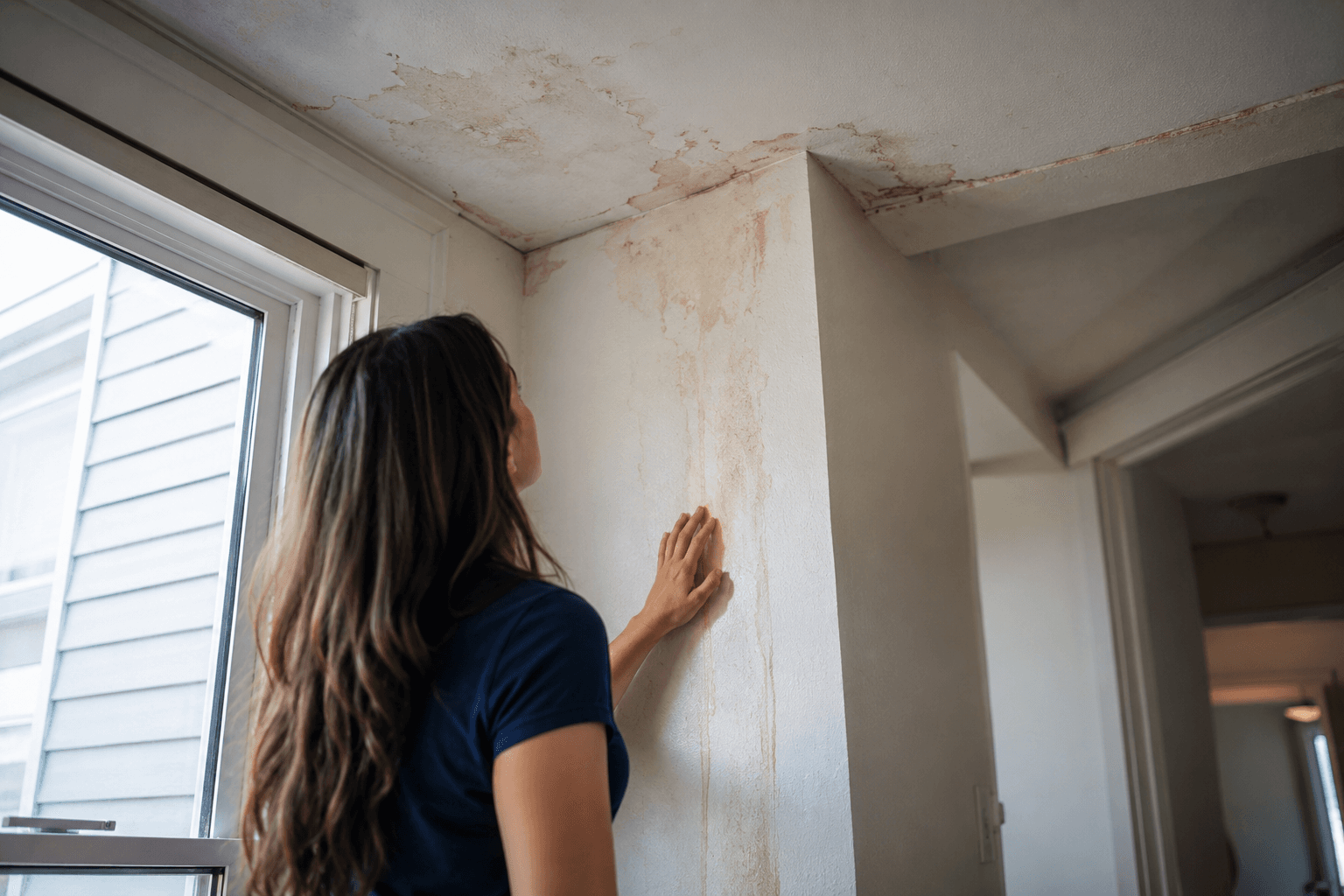
Visible surface changes mean moisture has already worked through the material. Watch for:
- A ceiling or wall stain that bleeds back through after you repaint it, which means the source is still active.
- Paint that bubbles, blisters, or peels in a defined patch rather than flaking with age.
- Wallpaper seams lifting or edges curling away from the wall.
- Stains with a yellow or brown ring, which indicates repeated wetting and drying rather than a one-time spill.
A stain that grows, darkens, or changes shape between one week and the next is an active leak, not an old one.
Structural Signs: Floors, Baseboards, and Trim
Wood tells you the truth about moisture. Hardwood that cups, with board edges rising higher than the centers, is absorbing water from below. Boards that crown, bulging in the middle, usually mean the flooring was sanded while still wet. Laminate that swells at the seams and a floor that feels soft or spongy underfoot both point to a saturated subfloor.
Baseboards and door casings swell, separate from the wall, or show a dark line along the bottom edge. Doors that suddenly stick in their frames during a season when they normally do not are worth a second look.
Slab and Foundation Signs
Charlotte's post-war rings, neighborhoods like Cotswold and Madison Park, added slab foundations with supply lines running through or under the concrete. A slab leak has its own signature: a warm spot on the floor from a hot water line, damp patches on carpet with no source above, or a hairline crack that stays wet.
In the older streetcar suburbs such as Dilworth, Plaza Midwood, and NoDa, the equivalent tell is in the crawl space. Standing water, condensation on ductwork, sagging insulation falling away from the floor joists, and rusted strapping all indicate a moisture problem that has been running long enough to change the structure.
The Signs in Your Bill and Your Fixtures
A water bill that climbs with no change in household routine is one of the most reliable indicators of a hidden leak, because water leaving a supply line is still metered. Compare against the same month last year rather than last month.
Fixtures show wear too. Look for green or white crusting on copper connections, rust at valve bodies and water heater fittings, and corrosion at the base of a toilet. Those deposits form where water has been escaping slowly and evaporating in place.
When Mold Is the First Thing You Notice
Sometimes visible growth is the first sign, which means moisture has been present for a while. The EPA advises that mold covering more than roughly 10 square feet generally warrants professional remediation, and that the underlying moisture source must be corrected or the growth will return.
Growth on the back of baseboards, inside cabinets under sinks, behind furniture on an exterior wall, or around window frames all indicate a moisture path rather than a surface cleaning problem. Our mold remediation crews work to the IICRC S520 standard, which requires containment and removal rather than surface treatment alone.
Frequently Asked Questions
How long does hidden water damage take to cause mold?
Per EPA guidance on moisture and mold, growth can begin on damp materials within 24 to 48 hours. Charlotte's summer humidity extends drying times, which widens that window.
Can I check for hidden water damage myself?
You can check the accessible things: look under sinks, read your water meter with everything shut off, walk the crawl space with a flashlight, and note any musty smells. Confirming moisture inside a wall or subfloor requires a moisture meter or thermal imaging.
Does homeowners insurance cover hidden water damage?
Policies typically cover sudden and accidental damage, while damage from a long-running leak is often treated as a maintenance issue and excluded. That distinction is why documenting when you discovered the problem matters. See our guide to insurance claims.
What does a professional moisture inspection involve?
A technician takes readings on affected and unaffected materials to establish a dry standard, maps the moisture across the area, and often uses thermal imaging to trace the path back to a source.
Suspect Hidden Water Damage in Your Charlotte Home?
The signs above rarely appear alone. One of them can be explained away; two or three in the same area usually means water is moving somewhere it should not.
If something in your home is telling you there is a leak, our water damage restoration team in Charlotte can take moisture readings, find the source, and give you a documented scope before the damage spreads further.