Why IICRC Certification Matters When Choosing a Restoration Company
Restoration is a trade with a low barrier to entry. Anyone can buy a truck-mount extractor and a set of air movers and start answering emergency calls, which is why the certification behind the company matters more here than in most home services.
IICRC certification is the industry's answer to that problem. It is worth understanding what it actually covers, because the distinction between a certified technician and a certified firm is one that marketing tends to blur.
Key Takeaways
- The IICRC is a nonprofit certifying body that develops the ANSI-accredited standards the restoration industry works to.
- Technician certification and firm certification are different things; ask which one a company holds.
- S500 governs water damage restoration and S520 governs mold remediation. Those are the standards your job should be run to.
What the IICRC Actually Is
The Institute of Inspection, Cleaning and Restoration Certification is a nonprofit organization that develops standards for the inspection, cleaning, and restoration industries and certifies both individual technicians and firms.
Its standards go through the American National Standards Institute process, which means they are developed by consensus among industry, insurance, and technical stakeholders rather than written by any single company. That is what makes them a credible reference point when an adjuster reviews a scope.
The Standards That Govern Your Job
Two documents cover most residential restoration work.
S500, the Standard for Professional Water Damage Restoration, defines the water categories and classes, sets out drying principles and psychrometry, and establishes documentation expectations for monitoring a structure to dry.
S520, the Standard for Professional Mold Remediation, covers containment, negative air pressure, worker protection, removal of affected materials, and the principle that remediation without correcting the moisture source is not remediation at all.
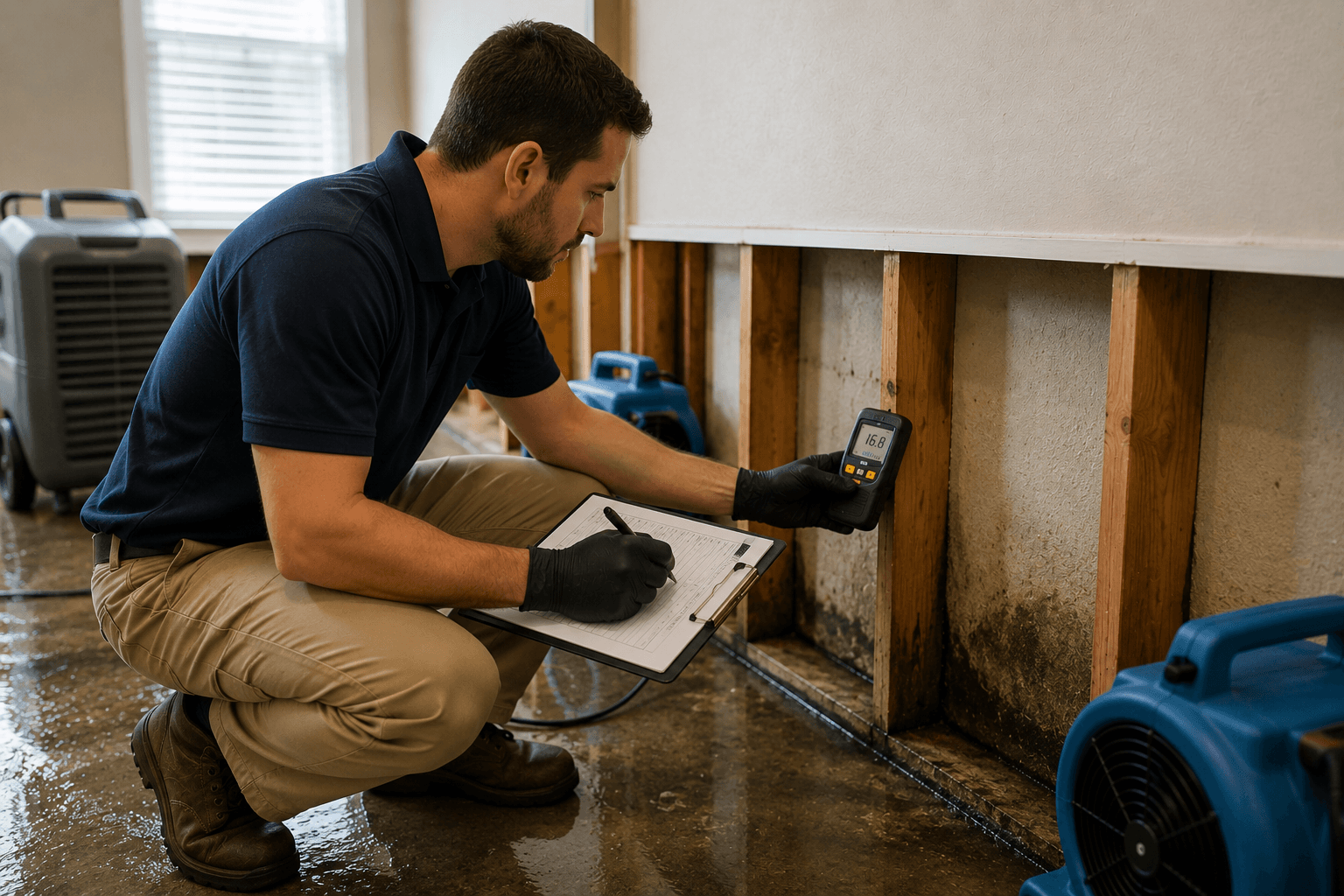
When a company says it follows S500, that should mean daily moisture readings against an established dry standard, not simply that fans were placed in a room.
Technician Certification Versus Certified Firm
These are distinct, and the difference matters when you are choosing a contractor.
Individual technicians earn certifications in specific disciplines. The common ones in residential work are WRT for Water Damage Restoration Technician, ASD for Applied Structural Drying, and AMRT for Applied Microbial Remediation Technician. Each requires coursework and examination, and continuing education to maintain.
A Certified Firm is a company-level designation with its own requirements, including maintaining certified technicians on staff, carrying insurance, and agreeing to a code of ethics and a complaint resolution process.
A company can employ one certified technician and describe itself in ways that imply more. The useful question is direct: how many of your technicians are certified, in which disciplines, and will a certified technician be on my job?
What Certification Changes on an Actual Job
The difference shows up in method and in paperwork.
A crew working to S500 establishes a dry standard by taking readings on unaffected materials, then measures affected materials against it. They calculate the equipment needed for the volume and class rather than guessing. They record temperature, relative humidity, and moisture content daily, and they dry to a documented target rather than stopping when the surface feels dry.
That last point is where uncertified work most often fails. Surfaces dry long before the material behind them does. A floor that feels fine underfoot can still hold enough moisture in the subfloor to support mold growth, and without meter readings nobody knows the difference until the smell appears weeks later.
Why It Matters for Your Insurance Claim
Adjusters evaluate restoration scopes against industry standards. A scope supported by daily moisture logs, documented dry standards, psychrometric readings, and photographs is one the carrier can approve without argument.
An undocumented scope invites questions, and questions become reductions. The documentation discipline that comes with working to S500 is, in practical terms, claim protection. Our insurance claims process is built around producing that record as the job runs rather than reconstructing it afterward.
Questions to Ask Before You Hire
A short list that separates certified operations from the rest:
- Which IICRC certifications do your technicians hold, and will a certified technician be on site for my job?
- Are you an IICRC Certified Firm, or do you employ certified technicians?
- Will you provide daily moisture readings and a documented dry standard?
- What is your drying goal for my materials, and how will you know when you have reached it?
- Are you licensed and insured in North Carolina, and can you provide a certificate of insurance?
A company that works to standard answers these easily. Hesitation is informative.
Frequently Asked Questions
Is IICRC certification legally required?
No. It is a voluntary industry certification rather than a government license, which is precisely why it functions as a differentiator. North Carolina contractor licensing is a separate requirement.
How do I verify a company's certification?
The IICRC maintains a public registry of certified firms, and you can ask any technician for their certification number directly. A reputable company will not object to the question.
Does certification cost me more?
Certified work is not automatically more expensive, and it is frequently less expensive overall, because correct drying the first time avoids the mold remediation and rebuild that follow an incomplete job.
What is the difference between WRT and ASD?
WRT covers water damage restoration fundamentals including categories, classes, and extraction. ASD goes deeper into the science of drying structures, covering psychrometry and equipment placement for difficult assemblies.
Working With a Certified Charlotte Restoration Team
Certification is not a logo on a truck. It is whether the crew in your home establishes a dry standard, documents readings daily, and dries to a target.
Our technicians hold WRT, ASD, and AMRT certifications, and our water damage restoration work follows the S500 standard from assessment through final readings. You can read more about our team and credentials on our about page.